
Frog Mechanics Lab

frog research

human research
2.3.2026 Welcome
We study how muscle properties affect our ability to move rapidly and accurately. We are motivated by: a) curiosity about the mechanical basis for behaviour, b) methods development for new ways of thinking and c) supporting human heath towards healthy ageing.
Recent publications
Explore some recent open-access work about muscle properties and sensorimotor control of human reaching.
View →
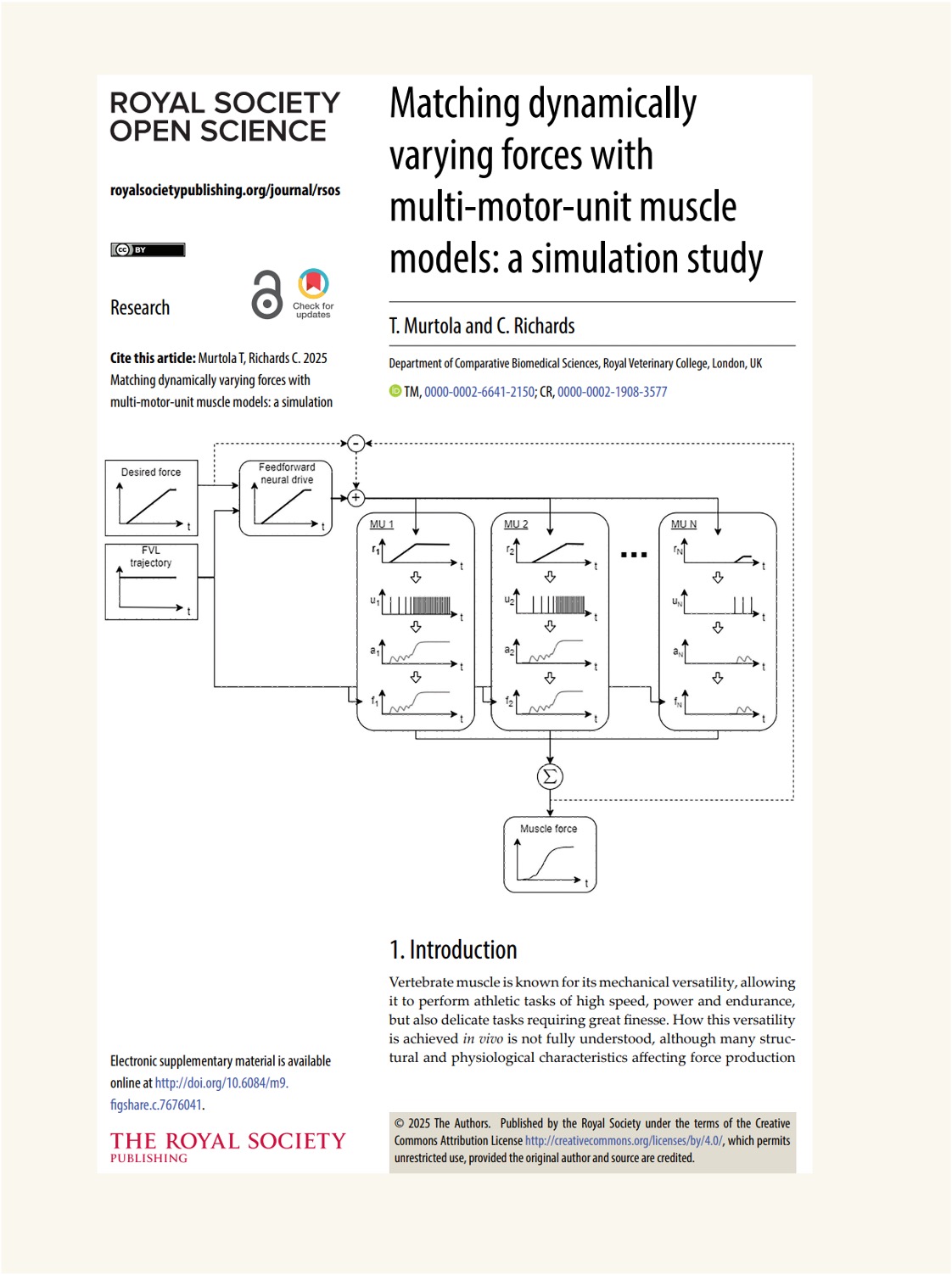
A new motor unit model
We made a mathematical model to simulate rate-coded control of multiple motor units.
Summary
How does the nervous system control muscles? Muscles have two primary features for neural control: 1) Division into multiple motor units, which are groups of fibres with shared properties, and 2) Rate-coded excitation in which the muscle is activated with repeated spikes from motor neurones. Both of these features are traditionally neglected in standard muscle models. We created a mathematical framework for modelling a force-control task by controlling instantaneous firing rates and motor unit recruitment.
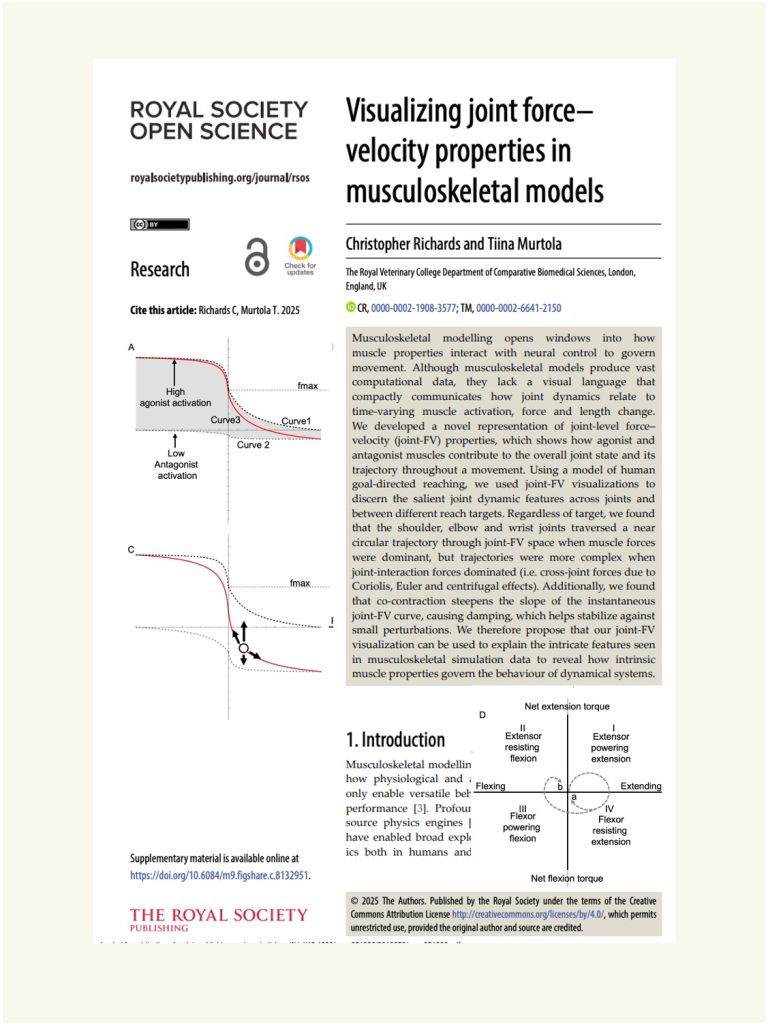
Joint force-velocity curve
We created a visualisation of muscle force-velocity properties at the joint level.
Summary
A salient feature of muscle behaviour is the Force-Velocity relationship (FV), meaning that muscles become weaker (less force) at higher speeds. When muscle forces combine to move a joint, the FV properties of the individual muscles add. We created a way to visualise a joint-level FV relationship in musculoskeletal simulations. We found that this visualisation helps us understand the complex mechanics of human reaching. We also found that co-contracting muscles (e.g. biceps and triceps acting in opposition) help the arm resist mechanical disturbances.
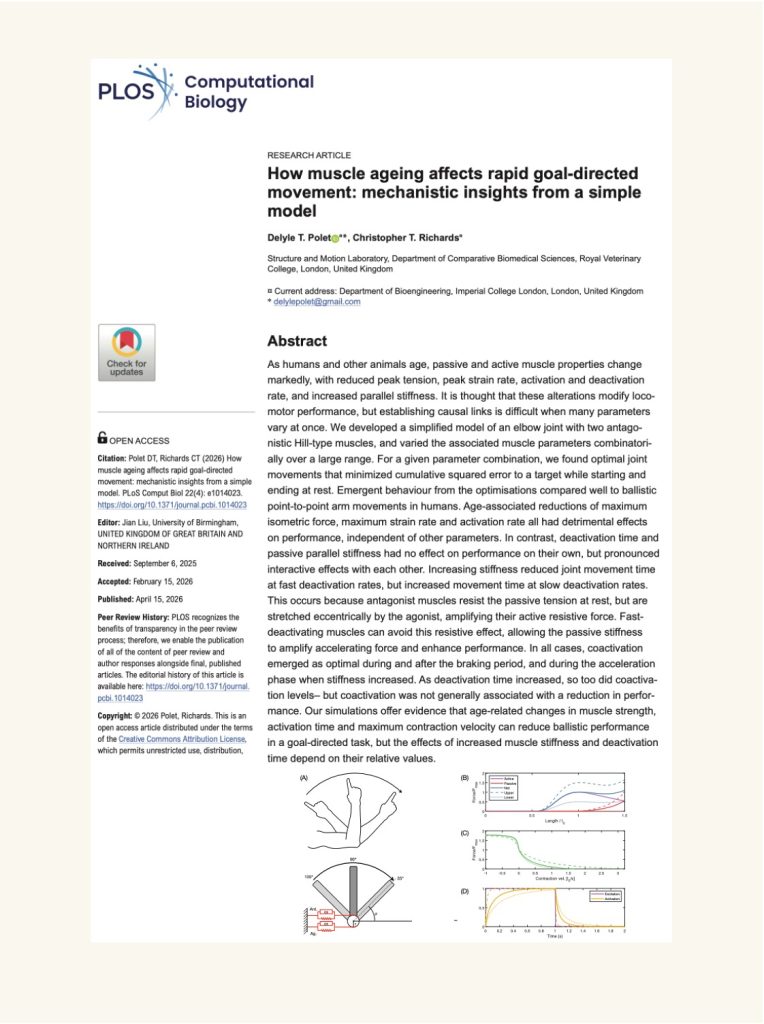
NEW! – Multiple effects of ageing on human reaching
We created a computer simulation of an elbow joint and “aged” the simulation by altering the muscle speed, strength and stiffness properties.
Summary
With age, muscles get weaker, less excitable, stiffer and slower, but which of these most affects reaching ability? We developed a simple elbow joint model to digitally “age” the muscle by modifying its properties. We found activation rate, peak force and maximum contraction speed most affect speed and accuracy. Additionally, if the muscle turns off quickly, high stiffness helps the arm move faster (slingshot-like). But, if the muscle turns off slowly, higher stiffness slows the arm. Our results suggest key muscle changes that slow movement with ageing.
frog talk
In this section we’ll be posting spotlights, commentaries and deep dives on selected topics within our work.